Wednesday, January 18, 2017

First Snorkel

Oh My Gosh .... i don't know how to tell you how pleased i am at being in these waters !
The last several years in Belize and Honduras, i’ve come to recognize and expect to see, what i’d come to name, 'the usual suspects’: Tangs, ParrotFish, and Sergant Majors, etc..   All though not ‘bored’ with them, i yearned for something new.   ...and new i got.  my first snorkel was complete overload !     i couldn’t decide where to look next.   all around me were colorful beautifully decorated fishes that i’ve never seen before.    i would start following one to try to get a photo; and another one would catch my eye; and a different one over there!    i’ve never seen so many different kinds of fishes.   There are categories that they all fall under:  AngelFish, ButterflyFish, BoxFish, TriggerFish, Grouper, etc.; but it is going to take me awhile to identify them by name.   To see so many different fishes all in one place is mind-boggling !    They are plentiful and beautiful !   i am truly in heaven !

Snorkeling through the shallows i found lots and lots of different Sea Stars  ... the ones with the bumps are called Chocolate Chip Sea Stars   :)


In the shallows you also see Sea Cucumbers, who are not usually very pretty, and they just lay there and do nothing.   This one was quite pretty, and i could see it’s little black mouth parts moving.


There are a lot of soft corals in the water; and almost no hard corals.   That is because this area suffered a typhoon 3 years ago, and it destroyed all the corals.   The soft corals can grow back quickly; but the hard corals, only grow a centimeter in a year (or something ridiculous like that).   so it will be another generation that will see them.  

This is a Leather Coral, large, and so fluffy.  It reminds me of a mushroom .. and i just found it in another book and they called it a MUSHROOM  Leather Coral  :)


You may possibly get tired of seeing the Anemone Fish aka ClownFish aka Nemo.    But before you do, here are some facts:
Clown Fish live in the Sea Anemone, hence the name.  The stinging tentacles of the Sea Anemone kills fish for it to eat.   The Clown Fish, is the only fish that does not get stung by these tentacles, because a mucous covers their body and protects them.     This relationship also provides the Clown Fish with some protection from predation by other fishes, and in return, the Clown Fish removes parasites and chases away species they may try to eat its host anemone. 

There are lots of different Clown Fish ... i think this one is a Red and Black Anemone Fish ...


I did not know this:   All Clown Fish are born Male, and can change to Female; but will only do so to become the dominant Female of a group.  Sex change is not particularly rare, but most species change from female to male. When Clown Fish hatch as males they join groups of a few individuals living together in a Sea Anemone.  The largest individual of each group is the only female; and she and the largest male are the only two that reproduce.  The dominant female lays her eggs on the reef, and the male fertilizes them.  Together, they guard the nest from egg predators.   If anything happens to the female, the reproductive male changes sex, becoming the dominant female.  The next largest male then becomes reproductively active, and the other males in the group continue to be subordinate.  The change is irreversible.

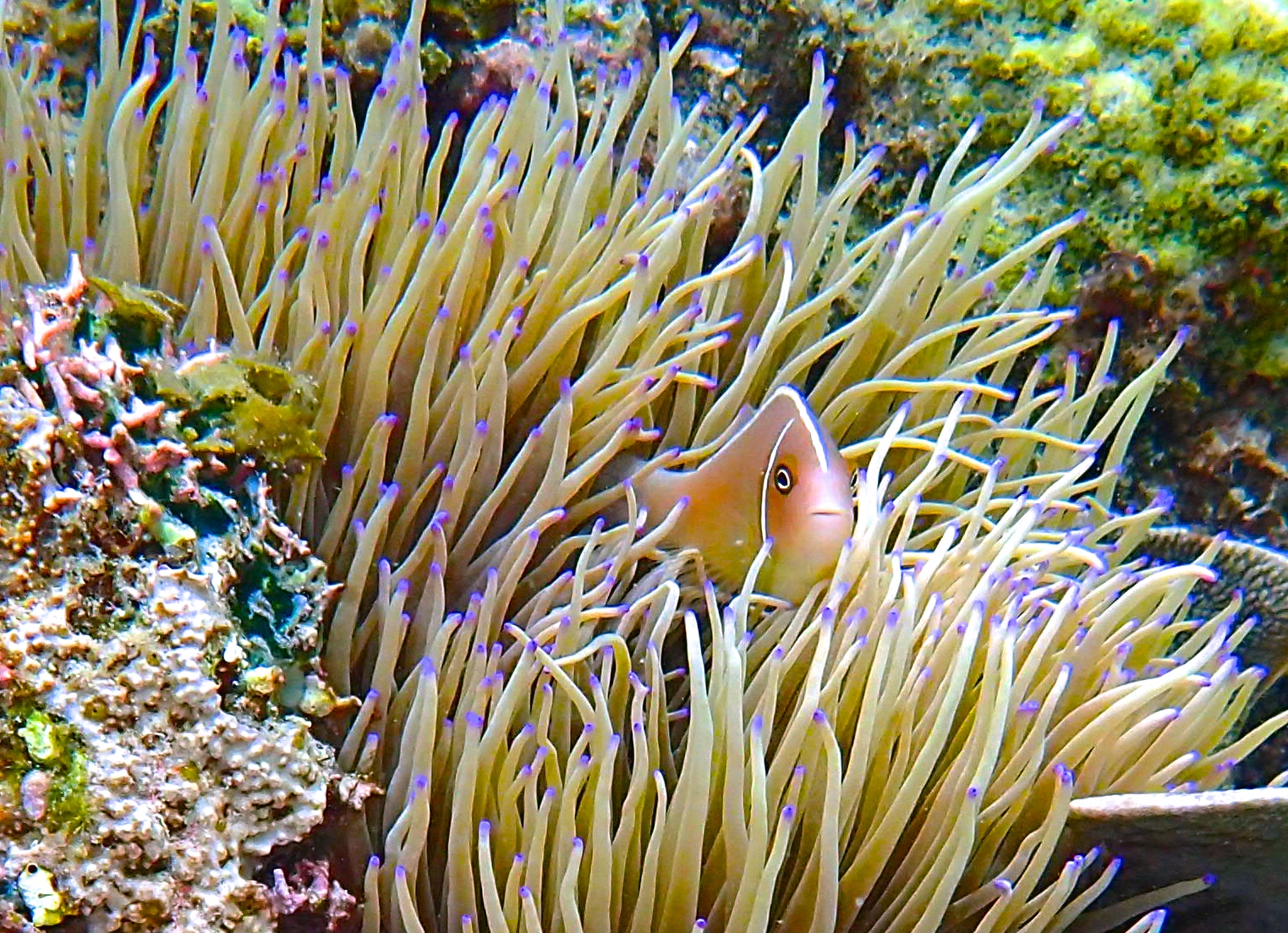
There are PINK Clown Fish, who knew  ... and so far this is my favorite photo...


i saw a couple of Groupers, but different from the Groupers i am used to seeing.
This a HoneyComb Grouper ...


and this is a Starry Grouper ...


This is a Regal AngelFish; and they seem to be plentiful here; or maybe it’s just because they are so bright and easy to see.


i’ve been lucky to spot 2 clams.   The first one was very small, maybe 2",  but very vibrantly colored;


the second one was larger and more subtle in color, but still fascinating.      This one was 6” across ....
now open ...


and now closed ... way cool !
i was intrigued by the small ‘teeth’ on the inside of it’s mouth ...
Clam Fact:  the clam gets only one chance to find a nice home.   Once it fastens itself to a spot on a reef, there it sits for the rest of its life.   i’ve heard there are Giant Clams north of Manila, 4 feet across and 500 pounds; but i don’t think i’ll make it up there this trip.


There are a lot of different and beautiful ButterFly Fish ... but i think this one is my favorite ... so far  :)
It is an Eastern Triangular ButterFly Fish ... stunning !
...and those little Damsel fishes, usually they are sky blue, but these are more turquoise  :)


another one  ... a Copper Banded ButterFlyFish


and this Japanese SurgeonFish .... the colors and lines are incredible !


i was quite a way down the beach from where i started, the weather was not cooperating and i got so cold that i thought i’d just snorkel up to shore where i was, get out, and warm up, then get back in the water.   it wasn’t until i got out that i realized that the sun was not shining…and it was raining.   but the air temp was still warmer than the water, so i warmed up a bit, then got back in the water.   the first thing i saw was this fish.    i didn't know the names of these new fishes; but i knew this one was a TriggerFish, so i named him Pink Tailed TriggerFish.   … ha … i looked him up, and i was right  :)


... then he blew me a kiss   :)


i was jumping (ok, maybe bobbing), for joy when i spotted this Fuchsia FlatWorm.    You would think it would be impossible to miss; but with so much to see, it could have easily been overlooked.    That would have been sad, because it was spectacular !     How big was it?  … maybe 1 inch.   .
i couldn’t find, or i should say understand, much about FlatWorms.  They’re called flatworms, but the name does little to describe them apart from the fact that they are, …  well, …. flat!    They eat tiny worms, microscopic matter, and even any insects.
Interesting: Good quality scientist can train flatworms to perform small task, such as finding water within a maze.
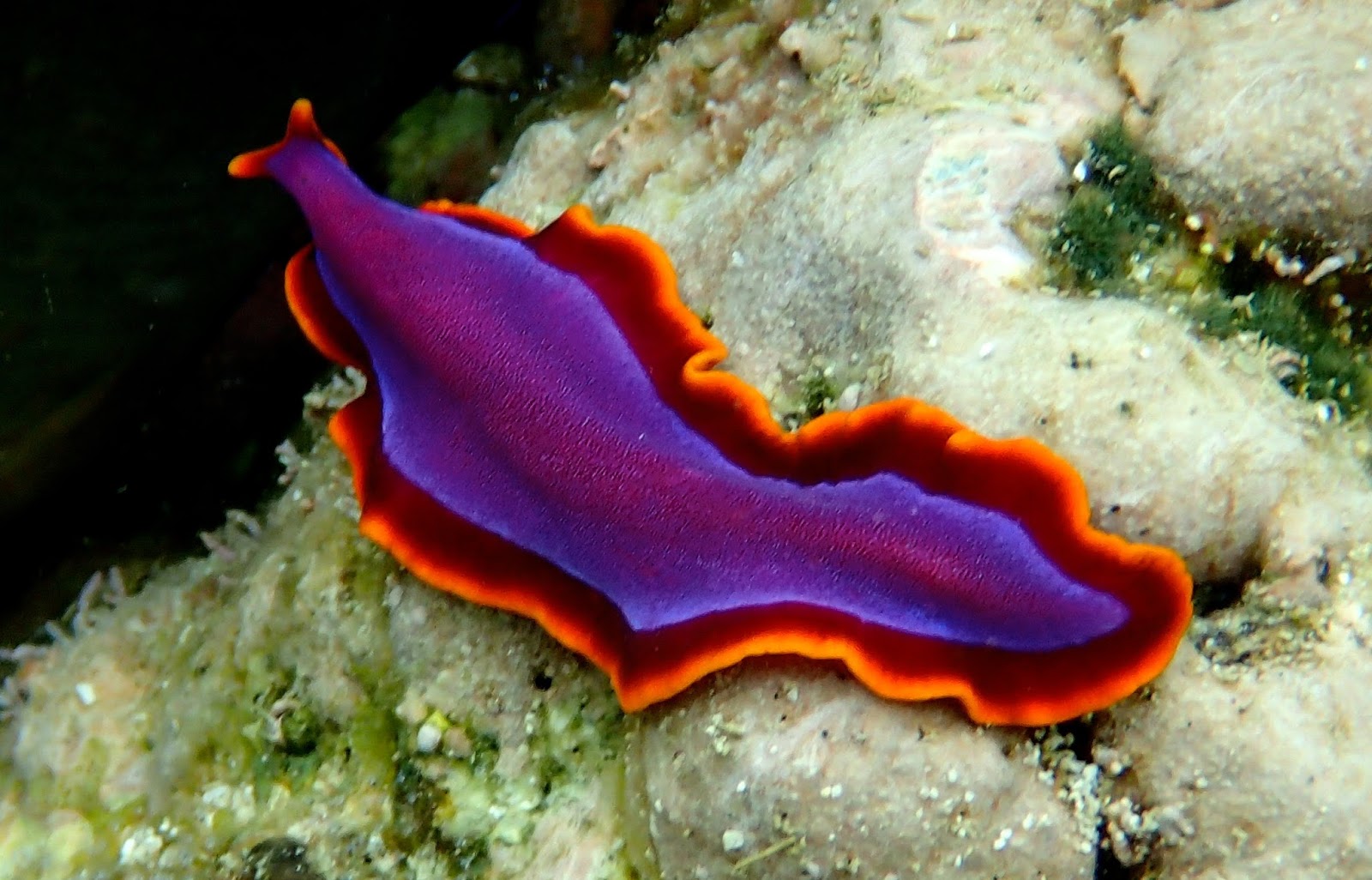


but, finding a flatworm on the reef, is pretty exciting because of their colors and designs … and watching them slide about with elegant ruffles of their body edges.   and i guess they can even swim by undulating their thin bodies.
This video shows those elegant ruffles.   
If you click on the little box in the lower right corner of the video box, it will enlarge to full screen.
If the video doesn't load for you, it can be seen on YouTube here:   https://www.youtube.com/watch?v=S0cRnDs5pW4


12


Monday, January 16, 2017

The PHILIPPINES -- NEW Adventure - 2017

I am in the Philippines ! ....
and let me start off with this ... i met NEMO ....my first day, my first dive ... a MAJOR goal of mine  :) 
fyi:   Nemo does not live anywhere in the waters of Belize nor Honduras; so i am pretty excited  :)
His home is in this Magnificent Anemone; more facts on that later.


Where in the World is the Philippines ?


and where am i ?
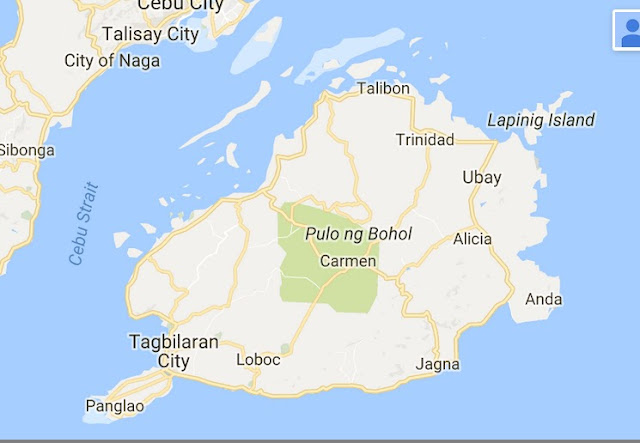
A little bit about where i am; here is a map of the Philippines.    The Island of Bohol is just below the center of the map.    It is not named, but is where it says ‘Chocolate Hills’ on the map.   I guess that gives you an idea about the importance they place on Chocolate Hills.   (more on Chocolate Hills later).   Just above that, Cebu, is where i flew into from Hong Kong. 


This map shows the Island of Bohol.   It is about 60 miles long, and 30 miles wide; so it’s no small island. ….. very much unlike Caye Caulker !    You can see Cebu City at the top.   I took a Ferry from there to Tagbilaran City, the ‘metropolis’.  We are in the Visayas Region and they speak Visaya, aka Cebuano.


We are on the smaller Island of Panglao, off the southwest corner of Bohol.    It is smaller, 16 miles, by 4 miles …  still very much unlike Caye Caulker.    It is about 30 minutes from Tagbilaran to Panglao.

Alona Beach is right at the bottom of the ‘g’ of ‘Panglao’, on the map above; and is more within my comfort range …  Dive Shops and restaurants with a sand street and the beach out front   :)


a bit about the Philippines:
28,241 beaches, mountain ranges that reach to almost 10,000 feet and a biodiversity that includes more than 13,500 plant species, almost 600 species of birds and 500 animal species. The Philippine population of 90+ million people is an eclectic mix of Philippine, Malay, Chinese, Spanish and Western cultures and includes 89 indigenous peoples groups, making the Philippines one of the most diverse and colorful tropical islands cultures in the World today.

i have been wanting to visit and explore this part of the earth’s oceans for a long time; and i am finally here !    made possible, mostly, through gracious friends, Kevin and Nadia, who i am now staying with; and helped me tremendously through the ‘getting here’ process.   i will be eternally grateful!

reaching this year's adventure took a bit longer than going to Belize.   i flew from Kalamazoo at 6am, or tried to, but because of engine trouble, we didn't leave until 11:30.   Fortunately this wasn't a problem for me, since my flight out of Chicago to Hong Kong wasn't until 2pm; so that's 8 hours.   the flight into Hong Kong was 16 hours, arriving the next day at 9pm.    hanging out for 11 hours in the Hong Kong Airport.    at 8am, i flew to Cebu, Philippines, another 3 hours.   taxi to the Ferry and the ferry ride to Tagbilaran,  3 more hours;   arriving at Kevin and Nadia's home, another hour .... leaving at 8 Jan at 6am, arriving on 10 Jan at 5pm ..... that's about a 40 hour journey to warm sunshine ....... unfortunately, it has been raining off and on since i got here; but not all day; and no snow either  :)

I am 13 hours ahead of you all in Kalamazoo, so if you want to know what the future holds for you, just let me know  :)

While in the Hong Kong Airport for 11 hours, i entertained myself by watching these girls plant this planter with these beautiful orchids of pink and yellow ... it was quite a production.  Unfortunately, i had to leave before they finished.


i've had 2 'reunions' already with friends i had met in Belize and Honduras.
First, i met Christopher, from Hong Kong, at Madi’s a couple of years ago.   he lives in Hong Kong and was departing at the same time as i was; so we met for an hour or so inside the Hong Kong airport.   it’s so much fun to catch up with people i’ve met through the years…. thanks to FaceBook for keeping us connected.


in the airplane from Hong Kong to Cebu City, i sat next to a girl who did not stop coughing the whole trip, and the one behind me was coughing, and 2 seats in front of me .... i finally resorted to putting on my mask.   After which, the girl sitting next to me decided it would be 'courteous' to put hers on too  :(


My new home .....  we are in the Penthouse on the 3rd floor


just a few minutes from Alona Beach


this is the view of the morning sunrise out my bedroom window.    The sun is rising over the water.


this is the family ...  Kevin, Nadia, and Viana, who is 6 years old; notice Viana is wearing the scarf i made for her  :)


my second reunion was with Greg, from Alaska.   we met 5 years ago in Utila, and through FaceBook learned that he was going to be in the Philippines.   He arranged his schedule to come visit me and arrived just a few hours after i did.  He found his way to Kevin and Nadia home, and they graciously invited him to stay here with us.   It was because of him that we dove that first day and met Nemo.   Normally, i wouldn’t have ‘dove’ into my diving that quickly.   He spent just a day and a half here, but it was great to see him too.   Kevin’s daughter, Viana and her friend Jody ‘fell in love’ with Greg ….ahhh, they had such a crush on him.  Jody even faked being sick from school, so she could see him  :)


My first dive was awesome !    On our way out to the Dive Site, our Captain shouted 'Whale Shark".    For those of you who have followed me, know that i spent 3 winters in Utila, volunteering at the Whale Shark Office, and never once saw a Whale Shark.   And here we are, first day out, and we encountered one.   Greg was in the water first and came eye to eye with it.    i was a little slower, and i saw him swimming under me.   but still ... pretty amazing!    There are Whale Sharks in these waters, but not generally here and that close to shore!   WoW !

the Dive Site was right out from of Alona Beach to the ‘Wall’ …. which is where the sand stops and drops off down a cliff.    You can see the Wall here.


There was a nice current, so we just let it take us long the wall, kind of like being on an escalator through an art gallery, while we looked in amazement.


All kinds of corals that i’ve never seen before.    They have been having a lot of rain and winds lately, so visibility was not that good, but since we were nose to nose with the wall, it didn’t make any difference for viewing.  


Feather Stars .... something new for me.  Your first lesson of the season   :)
I am seeing these pretty feathery creatures now for the first time.   They are called Crinoids or Feather Stars.   They are cousins of Sea Stars and Sea Urchins, members of the Echinoderm family, which means they all have the same basic 5-sided symmetry. 

Feather Stars differ from Sea Stars and Urchins, in that they:
--have multiple arms, but always divisible by 5
--they are much more ancient, fossil records back 450million years
—their mouth faces upwards, unlike Sea Stars and Urchins
—they can fasten themselves to the sea floor by a stalk, but
--they can also lose their stalk and swim and float
They use their feathery accouterments (i like that word) to capture plankton from the water to feed.
and i love the colors on the one in the photo below.


Fish and crabs eat them, and often their arms get used by smaller creatures as a hiding place, sometimes suffering damage themselves.  Like Sea Stars they are able to grow new arms to replace those lost as a distraction, or eaten by predators.

All this means that they are Animals … although they look like a Plant.
and check out that pink coral in the photo below !

I am going to start paying more attention and looking for these now   :)


These are Magnificent Feather Dusters, a type of tube worm.  They build tubes out of parchment, sand, and bits of shell, and then hide inside the papery tube when disturbed ... as seen in this photo:

and then eventually emerges again with it's feathery two-edged comb to capture food.    These are also in Belize and Honduras, so nothing new; but still fascinating.


more to come ...


Sunday, January 15, 2017

Inland 'Road Trip'


My first Sunday here, and Kevin offered to take me on a Road Trip with Nadia and Viana.   I suppose similar to a lot of us, they have not really explored their own little island, thinking ‘oh, we can do that someday’.    So, i think they were excited to be going.

First we stopped at the Mall to pick up a map  :)    This ‘Mall’, is HUGE, with literally EVERYTHING you need to buy; times 2.    The checkout lines were very long and slow…. i would not do well there.

Then we were off on our Road Trip.

Lots of traffic, lots of motor bikes and ‘tricycles’ that are like taxis.   It’s way more crazy than i am interested in exploring.   i would definitely not want to drive here, even though they do drive on the ‘right’ like us.

I have not had an opportunity to ride in a tricycle yet  :)

they are usually quite nicely painted;


We traveled about an hour along the southern coast, following the sea, through small towns, and then up winding roads, through a beautiful dark forest with very tall straight trees to our first stop, the Tarsier Sanctuary.

Meet the little Tarsier ! 


I’ve never heard of a Tarsier, so research was needed.   This is what i learned :
--one of the smallest known primates; but not a monkey
--about the size of a human fist
--in the family of lemurs
--prefer to remain upright
--a narrow bald tail, twice as long as body, used for balance
--eyes are enormous; larger than brain case and it’s stomach
--largest eye-to-body size ratio of all mammals
--eyes are fixed in its skull; they cannot turn in their sockets
--like an owl, head moves in a 180 degree arc
--name is derived from its elongated "tarsus" or ankle bone
--which allows it to leap 3 meters from tree to tree
--lower limbs twice the length of its trunk
--middle finger is elongated
--long digits have rounded pads, can grip almost any surface
--movements are similar to a frog
--thumb is not truly opposable, but the first toe is
--membranous ears are mobile, constantly moving, hearing all movements
--nocturnal, insect eating — don’t offer them a banana  :)
--are arboreal, living in and around tree trunks and roots
--live in groups of more than one male and one female
--female has multiple sets of breasts, but the only functional set is at the pectoralis
--the other breasts are used as anchor points for the newborn tarsiers
--gestation of about 6 months
--only one young is born at a time
--babies are born well-advanced state of development, fur & eyes open
--move about after 2 days, at 19 days move around like adults
--females are the care givers, no male parental care observed
--after two years, young tarsiers become sexually mature
--12-20 year life expectancy


Kinda creepy-cute, huh? 
Categorized as a "lower risk, conservation dependent”;  it could qualify as vulnerable-endangered within 5 years, if the present protection programs are stopped.  Catching and selling them as stuffed tarsiers has stopped; thankfully!   But destruction of habitat; by years of both legal and illegal logging, slash-and-burn agriculture have greatly reduced their forests, and reduced the tarsier population to a dangerously small size.   
The Tersier Sanctuary had no fences nor nets to keep them from leaving.    However, i assume they do feed them to keep them close by and cooperative for their tourist trade; and their own protection.   I was impressed by their care and organization.  There were lots of people around pointing out the little ones and reminding people not to get too close and not to use a flash.

Probably more than you wanted to know; but i thought it was very interesting; so i kept going  :)

i don't know why they put those smiles-grimaces on their faces ... but i had to follow


From the Tersier Sanctuary, we went to the ButterFly House; by request of Viana.   She wouldn’t go into the see Tarsiers, but was all excited about this one.


Not much new info here for an experienced butterfly-breeder like myself   :)    ....except that some of the butterflies have cross bread with another butterfly and had one side of their body different from the other.    They had several examples on display.   This is one of them.    Strange.


They had nice gardens for the butterflies too.   This was a huge flower, with 'garlic' in the name, although not related to garlic and did not smell like garlic  ??


This large black and white butterfly is their longest living butterfly at 9 months; the rest are the usual 2-3 weeks like ours.


Our little Tour Guide, a girl, was really very very good at her job.    It was a part time job for her, she is going to school, studying Forestry.    She took us around to everything and explained it all.      She was also very good at lining up people with butterflies in a glass case, and making it look like the people had wings on … and she asked me to jump for this one.   Look Mom, i'm a ButterFly, and i can fly! 


It was a fun stop !


Our next stop was Chocolate Hills.
There are +/- 1,776 grass-covered Hills, 100-390 feet tall, spread over an area of 20 square miles.
The Chocolate Hills are the country's third National Geological Monument and proposed for inclusion in the UNESCO World Heritage List.


There are many theories about how they formed, and most of them are scientifically unsubstantiated.     Even geologists have not reached consensus on how they where formed. The most commonly accepted theory is that they are the weathered formations of a kind of marine limestone on top of a impermeable layer of clay.
There is an observation hill with 214 steps; Viana, the 6yr old counted them :)  The plaque at the site makes reference they were once coral reefs that erupted from the sea in a geologic shift; but there are no volcanic rocks anywhere in the area, making this claim unsupported by scientific research.
But, do not be dismayed, there are several legends which are much more believable  :)
--2 giants hurling boulders at each other, then leaving their mess behind, forming the Hills....
more for the romantic ?
--a God fell in love with a simple mortal.   When she died, his tears dried, forming the Hills...
or more sinister ? …
--a giant animal was eating all their crops.   So the town piled rotten food where the animal couldn’t resist it.   The animal ate it, got sick, and defecated, drying to form the Hills

They are covered with grass, which, at the end of the dry season, turns chocolate brown, hence their name. At other times, the hills are green, and the association may be a bit difficult to make.   As you can see from my photos   :)


We completed a circle to get home …. stopping into McDonalds for dinner !    i think there is one in that huge Mall, besides this one, but that is it on this island.
Note the red Priority Lane sign on the right ... it says Senior Citizens ... i'm using that 'card' a lot down here  :)


a Fun Day !